 PD2V Web
From AI songs to my own app
How the songs I made with AI for fun turned into an app for videos that move to the beat. And what working with AI taught me along the way.
It started with songs
I make music with AI mainly for fun. At first it was more of a test: can AI sing in Czech? What will it do with ř, ž or š? And with a tongue twister that trips up even a human? We have a few songs like that, and to this day it's one of the best tests of what AI can do in music.
Then I started setting to music things I'd had written down for years: my own one-liners, lines from films and documentaries, various bits of wisdom. And finally songs based on ideas that grab me at the moment. Like lyrics made only from the titles of well-known songs. Or a song about Chuck Norris that I made after his death in March 2026, half as a tribute and half for a laugh.
Czech tongue twisters 01: Křup Křach, Křehký Křepelčí Křik. YouTube ↗
Czech interjections 01. YouTube ↗
A static photo isn't enough
I wanted to put the songs on YouTube. But almost all “AI clips” look the same: one photo with music underneath. YouTube, though, is about movement.
So I looked for a way to make a video that reacts to music. There wasn't much. And what there was, was either complicated or not very creative.
The app that was missing
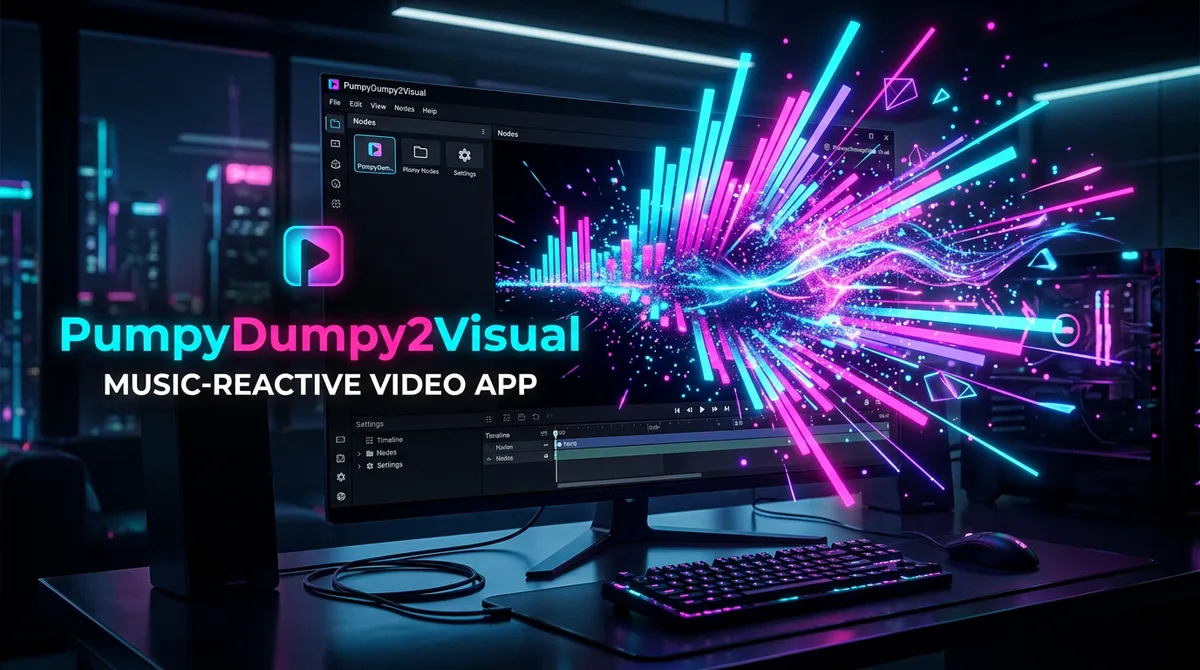
So I started building it myself. It was meant to be simple, creative and have lots of templates you just pick from. Today it's PumpyDumpy2Visual: a Windows app that runs offline and turns music into a video that moves to the beat. You load a track, pick a template and export the video. There are over 180 templates and over 90 objects. In the Free version the video has a watermark; Pro and Studio don't.
Tongue twisters with š, ž and ř, plus a video that reacts to the music. Made in PD2V. YouTube ↗
From an app for me to a product for people
At first it was just for me. But at some point I realised there's nothing like it anywhere and that it would be a shame to leave it in a drawer. So I released it and built a website for it, pumpydumpy2visual.com.
Then a second app came along, PumpyDumpy2AudioMaster (PD2AM). It improves the sound of a song. It works on its own, or as a companion to PD2V: first better sound, then the video.
Thousands of hours with AI
I built the apps and websites with AI. Not by writing one sentence and waiting for a miracle. Behind it are thousands of hours, and everything went through my hands and my decisions.
AI wrote song lyrics with me, I make the music in Suno (I started with Riffusion), and the code, the website texts and both apps came about with AI too.
It also taught me when not to trust it. It can sound convincing even when it's wrong. When people couldn't open our website over Wi-Fi, for a long time it kept telling me to fix something other than the real cause. In long work it forgets what we agreed on. And when it's allowed to touch files, it sometimes would love to deploy or delete something on its own. That's why I built myself the rules and guardrails I describe in the Set up AI section.
What I'd do differently
Honestly, I don't know. AI moves so fast that most of what it used to fail at, it handles today. And what it can't do yet, it will most likely manage soon.
What to take away
- Start with the thing you're missing. PD2V came about because I couldn't find anything that was enough for me.
- AI is a huge help, but the decisions and the checking stay with you.
- Before you let it near your files, give it rules and guardrails.